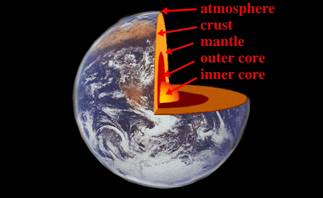
A simple image of Earth and the interior layers. Windows
to the Universe, at (http://www.windows.ucar.edu) at the University
Corporation for Atmospheric Research (UCAR). ©1995-1999, 2000 The Regents of
the University of Michigan; ©2000-05 University Corporation for Atmospheric
Research.
The Sunnah of Prophet Muhammad is the second revealed
source of Islam. Like the Quran, it contains scientific information
unavailable 1400 years ago. From these miracles is the “seven” earths,
mentioned by the Prophet in several of his sayings. From them are the
following two:
Hadith 1
It was narrated on the authority of Abu Salamah that a
dispute arose between him and some other people (about a piece of land). When
he told Aisha (the Prophet’s wife) about it, she said, ‘O Abu Salamah! Avoid
taking the land unjustly, for the Prophet said:
“Whoever usurps even one span of land of somebody, its
depth through the seven earths will be collared to his neck.” (Saheeh
Al-Bukhari, ‘Book of Oppression.’)
Hadith 2
Salim narrated on the authority of his father that the
Prophet said:
“Whoever takes a piece of land of others unjustly,
he will sink down the seven earths on the Day of Resurrection.” (Saheeh Al-Bukhari,
‘Book of Oppression.’)
The aforementioned hadith prohibits oppression in
general, especially the taking of a piece of land belonging to others unjustly. What might the seven earths refer to?
Studies in geology have proven that the earth is
composed of seven zones, identified from the inner to the outer layers as
follows:
(1) The Solid Inner Core of Earth: 1.7% of the
Earth’s mass; depth of 5,150 - 6,370 kilometers (3,219 - 3,981 miles)
The inner core is solid and unattached to the mantle,
suspended in the molten outer core. It is believed to have solidified as a
result of pressure-freezing which occurs to most liquids when temperature
decreases or pressure increases.
(2) The Liquid Outer core: 30.8% of Earth’s mass;
depth of 2,890 - 5,150 kilometers (1,806 - 3,219 miles)
The outer core is a hot, electrically conducting liquid
within which convective motion occurs. This conductive layer combines with Earth’s
rotation to create a dynamo effect that maintains a system of electrical
currents known as the Earth’s magnetic field. It is also responsible for the
subtle jerking of Earth’s rotation. This layer is not as dense as pure molten
iron, which indicates the presence of lighter elements. Scientists suspect
that about 10% of the layer is composed of sulfur and/or oxygen because these
elements are abundant in the cosmos and dissolve readily in molten iron.
(3) The “D” Layer: 3% of Earth’s mass; depth of
2,700 - 2,890 kilometers (1,688 - 1,806 miles)
This layer is 200 to 300 kilometers (125 to 188 miles)
thick and represents about 4% of the mantle-crust mass. Although it is often
identified as part of the lower mantle, seismic discontinuities suggest the “D”
layer might differ chemically from the lower mantle lying above it. Scientists
theorize that the material either dissolved in the core, or was able to sink
through the mantle but not into the core because of its density.
(4) Lower Mantle: 49.2% of Earth’s mass; depth of
650 - 2,890 kilometers (406 -1,806 miles)
The lower mantle contains 72.9% of the mantle-crust mass
and is probably composed mainly of silicon, magnesium, and oxygen. It probably
also contains some iron, calcium, and aluminum. Scientists make these
deductions by assuming the Earth has a similar abundance and proportion of
cosmic elements as found in the Sun and primitive meteorites.
(5) Middle Mantle (Transition region): 7.5% of
Earth’s mass; depth of 400 - 650 kilometers (250-406 miles)
The transition region or mesosphere (for middle mantle),
sometimes called the fertile layer, contains 11.1% of the mantle-crust mass and
is the source of basaltic magmas. It also contains calcium, aluminum, and
garnet, which is a complex aluminum-bearing silicate mineral. This layer is
dense when cold because of the garnet. It is buoyant when hot because these
minerals melt easily to form basalt which can then rise through the upper
layers as magma.
(6) Upper Mantle: 10.3% of Earth’s mass; depth of
10 - 400 kilometers (6 - 250 miles)
The upper mantle contains 15.3% of the mantle-crust mass.
Fragments have been excavated for our observation by eroded mountain belts and
volcanic eruptions. Olivine (Mg,Fe)2SiO4 and pyroxene (Mg,Fe)SiO3 have been
the primary minerals found in this way. These and other minerals are
refractory and crystalline at high temperatures; therefore, most settle out of
rising magma, either forming new material or never leaving the mantle. Part of
the upper mantle called the asthenosphere might be partially molten.
(7) Lithosphere
Oceanic crust: 0.099% of Earth’s mass; depth of 0-10
kilometers (0 - 6 miles)
The rigid, outermost layer of the Earth comprising the
crust and upper mantle is called the lithosphere. The oceanic crust contains
0.147% of the mantle-crust mass. The majority of the Earth’s crust was made
through volcanic activity. The oceanic ridge system, a 40,000-kilometer
(25,000 mile) network of volcanoes, generates new oceanic crust at the rate of
17 km3 per year, covering the ocean floor with basalt. Hawaii and Iceland are two examples of the accumulation of basalt piles.
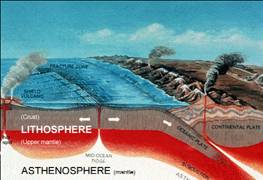
This image shows a cross section through the earth’s crust
and upper mantle showing lithosphere plates (made of the crust layer and the
top part of the mantle) moving over the asthenosphere (upper mantle). Windows
to the Universe, at (http://www.windows.ucar.edu) at the University
Corporation for Atmospheric Research (UCAR). ©1995-1999, 2000 The Regents of
the University of Michigan; ©2000-05 University Corporation for Atmospheric
Research. Continental crust: 0.374% of
Earth’s mass; depth of 0-50 kilometers (0 - 31 miles)
The continental crust contains 0.554% of the
mantle-crust mass. This is the outer part of the Earth composed essentially of
crystalline rocks. These are low-density buoyant minerals dominated mostly by
quartz (SiO2) and feldspars (metal-poor silicates). The crust (both oceanic
and continental) is the surface of the Earth; as such, it is the coldest part
of our planet. Because cold rocks deform slowly, we refer to this rigid outer
shell as the lithosphere (the rocky or strong layer).
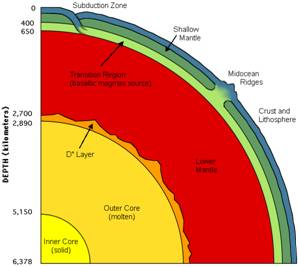
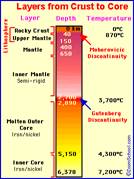
This image shows the divisions of the Earth’s interior into
7 layers. (Adapted from Beatty, 1990).
Conclusion
The layers of the earth coincide with the above mentioned
hadith of the Prophet. The miracle is in two matters:
(1) The expression of the hadith, ‘He will sink
down the seven earths on the Day of Resurrection,’ indicates the
stratification of these “earths” around one center.
(2) The accuracy with which the Prophet of Islam
referred to the seven inner layers of earth.
The only way for a desert dweller to have known these
facts 1400 years ago is through revelation from God.
References
Beatty, J. K. and A. Chaikin,
eds. The New Solar System. Massachusetts: Sky Publishing, 3rd Edition, 1990.
Press, Frank and Raymond Siever.
Earth. New York: W. H. Freeman and Company, 1986.
Seeds, Michael A. Horizons. Belmont, California: Wadsworth, 1995.
El-Najjar, Zaghloul. Treasures
In The Sunnah: A Scientific Approach: Cairo, Al-Falah Foundation, 2004.